Igbo culture is not a collection of customs. It is a theory of the world — a set of answers to the questions that every human society must answer: how should authority be organised, how should the dead be honoured, how should the self be understood in relation to the community, and what does it mean to live well?
From the Compound to the Cosmos
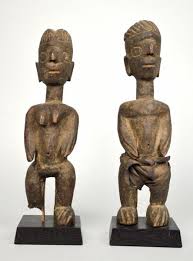
Igbo cultural life is organised around a series of concentric circles. At the centre is the individual — their chi (personal spirit), their ikenga (the deity of personal achievement that every Igbo man of standing maintains), and their obi (the reception hall of their compound that is simultaneously a domestic space and a public one). Around the individual is the family — the extended family unit that shares a compound, worships common ancestors, and bears collective responsibility for individual conduct. Around the family is the lineage — the larger kinship group that traces descent from a common ancestor. Around the lineage is the village. Around the village is the wider community of Igbo-speaking peoples.
The Ikenga: Personal Achievement as Sacred
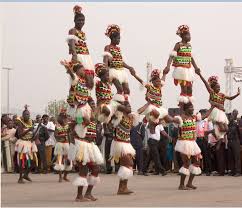
The ikenga — a carved wooden figure, typically depicting a seated man with ram's horns, holding a sword and a trophy head — is one of the most distinctive objects in Igbo material culture. It is the physical embodiment of the principle of personal achievement: the Igbo belief that a person's success in life is their own accomplishment, earned through effort, skill, and the favour of their chi. The ikenga is not a generic deity; it belongs specifically to its owner and embodies specifically that owner's achievements and aspirations.
Every Igbo man of standing maintains an ikenga in his obi. He feeds it with palm wine and kola nut at significant moments — before important decisions, after successes, to seek guidance in difficulty. When a man dies, his ikenga is split — the two halves placed in the grave with him — because the personal deity of achievement belongs to the individual and cannot be inherited. His son must establish his own ikenga, representing his own achievements, not his father's.
The Arts as Cultural Practice
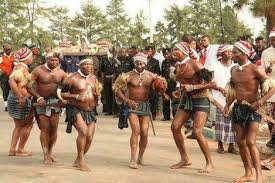
Igbo artistic traditions are among the richest in West Africa. The bronze castings of Igbo-Ukwu — dated to the 9th century CE — demonstrate that Igbo artistic achievement has deep historical roots. The Uli body-painting tradition of Igbo women — fluid, biomorphic lines encoding symbolic information — is one of the distinctive visual signatures of Igbo aesthetic culture. The akwete weaving of the women of Akwete in Abia State produces cloth of great complexity and beauty that has been traded across West Africa for centuries. Music — the ogene (iron gong), the udu (clay pot drum), the oja (flute) — pervades Igbo cultural life at every level.
Food as Culture
Igbo cuisine — built on yam, palm oil, and pepper — is inseparable from Igbo cultural identity. The New Yam Festival is the most important event in the Igbo ritual calendar precisely because yam is not merely food but a cultural symbol: the crop around which the agricultural year revolves, the measure of a man's wealth in his yam barns, the subject of communal thanksgiving that maintains the relationship between the community and the divine forces that make the harvest possible. To eat together, to share food, to offer food to guests — these are not merely social acts but expressions of the deepest Igbo values of community, hospitality, and reciprocal obligation.