
The Igbo masquerade tradition — mmanwu — one of the most complex and widely practiced performance traditions in Africa, and the primary medium through which the ancestral world is made present in the world of the living.
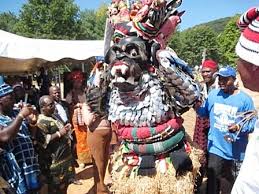
What Masquerade Is
The Igbo masquerade (mmanwu) is not a theatrical performance in the Western sense. It is not entertainment, though it entertains. It is not merely symbolic, though it is rich in symbolic meaning. It is, within the framework of Igbo cosmology, an actual manifestation of the ancestral world in the world of the living — a presence, not a representation. When the masquerade appears, an ancestor or spirit being has entered the community. The performer who wears the mask is not "playing" a spirit; he has become the medium through which the spirit acts.
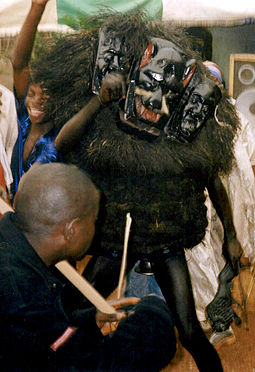
The Varieties of Masquerade
Igbo masquerade is not a single tradition but a family of traditions that varies significantly across different regions and communities. Gentle masquerades return as benign ancestral presences to celebrate community festivals. Enforcement masquerades — like the Ekpe and Okonko — exercise actual coercive authority: collecting debts, enforcing community decisions, punishing anti-social behaviour. Warrior masquerades embody martial values and controlled aggression. Liminal masquerades appear at funerals and initiation ceremonies, marking transitions between states.
The Secrecy Principle
Women and uninitiated men are officially not supposed to know that masquerades are performed by human beings. The fiction of actual ancestral presence is maintained by strict social protocols. In practice, virtually all adult Igbo know perfectly well that masquerades are performed by men. The social fiction is maintained not because anyone is genuinely deceived but because the maintenance of the fiction is itself a social act that sustains the tradition's authority. The unmasking of a masquerade — the deliberate public exposure of the performer — is a serious social offence equivalent to a desecration.
Masquerade and Gender
The masquerade tradition is exclusively male — only men perform masquerades, only men are initiated into the knowledge of how masquerades work, and women's exclusion is structural. This dimension has been critically examined by Igbo feminist scholars including Ifi Amadiume. Women have their own parallel ritual traditions — women's dances, the ụmụada institution, women's market associations — that are not simply the feminine counterpart of masquerade but independent traditions with their own authority.
Masquerade in the Contemporary World
The masquerade tradition has survived colonialism, Christianisation, urbanisation, and diaspora in recognisably continuous forms. In the diaspora, masquerade performances are staged at cultural festivals as demonstrations of Igbo heritage, connecting diaspora Igbo to a tradition that many grew up knowing only partially.